AI readiness and enteprise IT challenges in 2026
While digital transformation is often discussed at a high level, daily operations tell a different story. Many organizations still struggle with fragmented systems, slow processes and limited IT capacity.
At the same time, expectations around AI are growing. But without structured data, clear ownership and a single source of truth, AI cannot deliver real value. When critical data lives in multiple Excel files, emails and disconnected tools, AI has no reliable foundation to work with.
The goal of this article is to share patterns and insights that repeatedly arise in enterprise environments today – based on real conversations and hands-on experience. It is written for IT leaders, business users and decision-makers who are looking to improve how their organizations build and connect internal processes.
The state of enterprise IT in 2026
Enterprises often invest in core systems like ERP, but many critical workflows still run outside those systems: manually, inconsistently and without clear ownership.
As we move toward 2026, expectations are shifting. Leadership expects faster results, clearer ROI and better visibility. IT teams are expected to deliver more with the same or fewer resources. End users expect simple, intuitive tools that fit into their daily work, not complex systems that slow them down.
Big transformation projects still exist, but fewer organizations want to wait years for results. The focus is shifting to smaller changes that deliver value fast, while keeping core systems in place.
The enterprise decision-making landscape
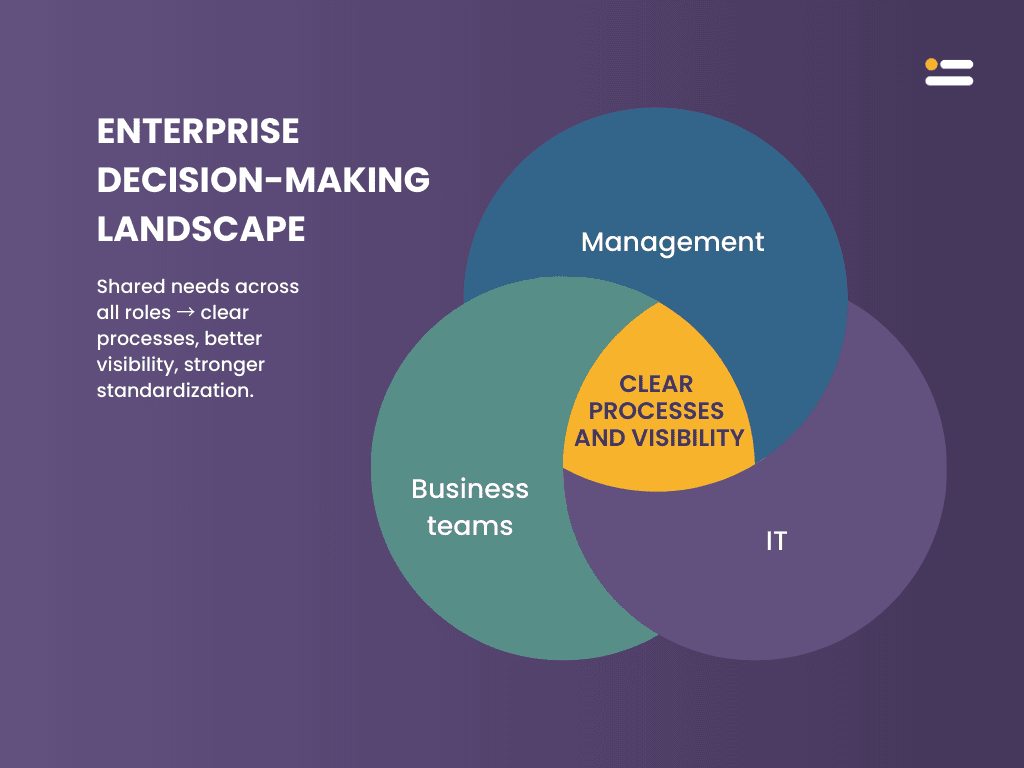
Enterprise decisions involve multiple roles:
- Management focuses on ROI and efficiency
- Business teams want simpler tools that fit daily work
- IT needs relief from operational overload.
Despite different priorities, all roles share the same needs: clearer processes, better visibility, and stronger standardization.
Validated patterns across enterprises
Over the past nine years, our team at Unitfly have worked closely with medium and large enterprises across different industries, helping them improve processes, connect systems, and deliver internal applications that actually get used.
What we consistently see is a gap between long-term digital transformation plans and day-to-day operational reality. Below are some of the common challenges we identified.
Fragmented IT ecosystems
Most medium and large companies operate with a large number of parallel systems. Each department tends to introduce tools to solve its own problems, often without a shared structure or long-term alignment.
As a result, information is scattered across ERP systems, DMS platforms, SharePoint, Excel files, ticketing tools, email and so on. Overlapping functionality is common, and no single place provides a complete view of what is happening.
Limited IT capacity and operational overload
IT teams are under constant pressure to keep systems running and support daily operations. In many organizations, most IT capacity is spent on maintenance and support, leaving little time for optimization or new development.
Changes to core systems like ERP often take months. Issues and bug fixes take priority, while improvements are postponed, even when they would clearly improve efficiency. Even when process problems are evident, solving them takes time the IT team does not have.
Slow user adoption and resistance to change
Although technical implementation can be long and demanding, user adoption often lasts just as long (or longer). New tools are deployed, but usage remains low.
Complex interfaces, unclear processes and tools that do not fit daily workflows make users fall back to familiar solutions, even when better systems are deployed.
Strong dependence on Excel and email workflows
Even with ERP and other enterprise systems in place, many everyday processes still happen in Excel and email.
Teams track work in spreadsheets, send approvals by email, and manually update status files. Over time, this creates confusion: multiple versions of the same file, unclear responsibilities, and no single view of what is actually happening.
Lack of clear process ownership
In many organizations, it’s not clear who is responsible for a specific process. Business teams often assume IT will take ownership, while IT expects the business to define and manage it.
As a result, processes fall into a gray area. Improvements are delayed, decisions take longer than necessary, and even small changes require multiple discussions and approvals. Over time, this creates frustration on both sides and leaves many processes unchanged: not because they are not important, but because no one clearly owns them.
Unstructured data limits AI adoption
Many organizations talk about AI, but their data foundations are not ready for it. Key business data still lives in Excel files, emails and local tools, often duplicated across multiple sources.
When two spreadsheets show the same budget with different numbers or context, there is no clear source of truth. Without structured data models, consistent processes and clear ownership, AI systems cannot reliably execute tasks or support decision-making. In practice, data governance and process standardization are a prerequisite for any meaningful use of AI or agent-based systems.
Difficulty measuring and tracking processes
When processes are spread across different tools and spreadsheets, tracking them becomes difficult. Data is inconsistent, updates are manual, and there is no single place to see what is really happening.
As a result, leadership lacks real-time visibility into process status and key metrics. IT teams also struggle to identify bottlenecks early, because there is no clear view of how processes actually perform.
Need for agility and “quick win” solutions
Large transformation initiatives are still on the table, but fewer organizations are willing to run long and complex projects.
Instead, companies prefer small, focused improvements that deliver quick results and a clear business value, without changing or replacing core systems. Quick wins build trust and reduce resistance to change.
Desire for simpler user experience
User experience has become a critical success factor. People want tools that help them do their job, not slow them down. Clean interfaces and clear workflows directly impact adoption and long-term value. Tools that show only what’s relevant for each role make work less confusing and more efficient, and users are more likely to actually use them.
Strong demand for process standardization
In many organizations, processes and ways of working vary between teams, divisions or locations. This makes coordination harder and creates confusion when tasks move across departments. Clearer, shared standards can make operations smoother, decisions faster and collaboration easier across the company.
Standardization becomes especially important in multi-country organizations, group structures, and companies going through mergers or restructuring.
From vendors to advisory partners
Enterprises aren’t just looking for another tool. They want partners who understand how their organization works, can suggest best practices, and guide them in setting standards. It’s about getting advice and support, not just features.
Key confirmed challenges across medium and large companies
Several challenges include:
- Fragmented systems and too many separate tools
- Inconsistent and unclear processes
- IT teams overloaded with support work, with little time for improvement
- Users struggling with complex tools, relying on Excel and email
- Unclear ownership of processes, slow decisions
- No single source of truth, which limits the effective use of AI
- Limited visibility for leadership into performance and bottlenecks.
In the end, these challenges affect everyone in the organization. Employees waste time on complex tools and unclear processes. IT teams are overloaded just keeping things running. Leaders can’t see clearly how work is progressing. All of this slows decisions, reduces efficiency, and makes it harder for the company to meet business objectives.
Key opportunities for no-code
Despite these challenges, there are clear opportunities to make enterprise work easier and more efficient.
No-code platforms let organizations create applications without traditional coding.
Thanks to no-code development:
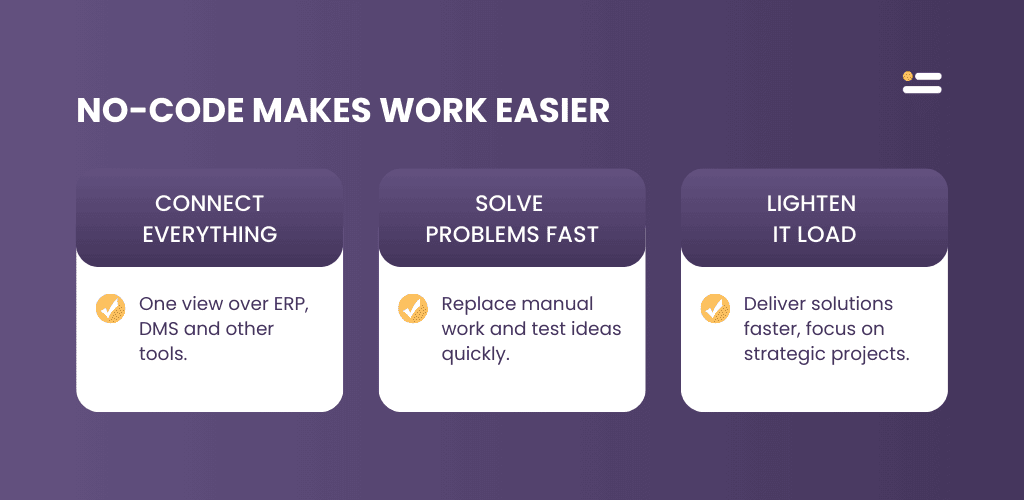
- A single layer over existing systems can connect ERP, DMS and other sources, giving everyone one clear view of data without changing the core tools. It also makes it easier to harmonize systems during organizational changes.
- Small, focused applications can solve real problems quickly. They can replace manual Excel and email workflows, digitalize approvals and tracking, provide simple role-based interfaces and let teams test ideas fast before making bigger investments.
- These approaches take pressure off IT teams. They can deliver solutions faster, reduce backlogs of small requests and spend more time on strategic projects instead of just reactive support.
No-code platforms make this approach accessible to both IT and business teams. They allow organizations to build, test and deploy internal applications without heavy development cycles.
Conclusion
Enterprise IT environments face many challenges: fragmented systems, slow processes, heavy reliance on Excel and email, unclear process ownership and overloaded IT teams. These issues make it harder to track work, deliver results quickly and give users the tools they need.
Before enterprises can leverage AI effectively, they first need to do their homework: clean up data, clarify ownership, and create a single source of truth. Without this foundation, AI cannot deliver accurate insights or support decision-making reliably. These steps are essential to prepare organizations for long-term AI initiatives.
At the same time, there are clear opportunities. Small, focused applications, unified views across existing systems and simpler interfaces can improve adoption, speed up workflows and reduce pressure on IT.
No-code platforms make these solutions accessible, letting organizations test ideas, standardize processes and focus on strategic work. By embracing these approaches, enterprises can bridge the gap between business needs and IT capacity and create tools that actually get used.
If you want to see how quickly you can start improving processes, you can try our no-code platform Auclio for free here: Start your free trial.